






Medium Speed EDM Wire Cutting CNC Machine
Due to the special physical and chemical properties of aluminum alloys, there are many problems in Medium Speed EDM Wire Cutting CNC Machine. For example, etchants (i.e. alumina) are prone to adhere to electrode wires;

- Product Introduction
Due to the special physical and chemical properties of aluminum alloys, there are many problems in Medium Speed EDM Wire Cutting CNC Machine. For example, etchants (i.e. alumina) are prone to adhere to electrode wires; Electrocorrosion particles are relatively large, and machining gaps are prone to clogging. The longer the processing time, the more aluminum oxide adheres to the electrode wire, and the poor conductivity of aluminum oxide will affect the discharge performance of the electrode wire and accelerate the wear of the feeding block. In addition, when cutting rust proof aluminum alloy, sparks can also be found between the electrode wire and the bond block. In response to the above issues, this article explores how to use medium wire cutting to cut rust proof aluminum alloys from two aspects: the causes and treatment measures.
1 Analysis of the reasons for the adhesion of machining chips to electrode wires
▲ (1) Improper matching of parameters for pulse power supply
During wire electrical discharge machining, the initial stage after gap breakdown is mainly spark discharge, and its erosion process is mainly carried out in the form of vaporization and evaporation. As time goes on, the discharge form changes from spark discharge to transitional arc discharge, and the erosion process at this time is mainly carried out through thermal action and the pressure generated by the discharge column on the discharge marks. The higher the pressure generated by the discharge column on the discharge mark, the faster the molten material is ejected, and the diameter of the spherical machining chips formed in the cooling medium is smaller. Calculations show that the pressure P at the discharge point is directly proportional to the discharge peak current Im and inversely proportional to the discharge time T. When Im is determined, P decreases with the increase of T, resulting in an increase in the diameter and volume of the workpiece, leading to an increase in the thermal inertia of the machining chips, which is difficult to handle. Therefore, a wider pulse width can easily generate larger machining chips and adhere to the electrode wire.
But if the pulse width is narrow and the interval is too small, it will also produce large machining chips. This is because the pulse interval is too small, which will cause insufficient ionization. At this time, it is likely that there will be multiple consecutive discharges at a certain channel. Due to the continuous decrease in insulation strength before each breakdown at this location, the channel diameter may increase and the corresponding current density may decrease, resulting in a decrease in the pressure of the discharge column on the discharge mark and the generation of larger machining chips. Due to the strong affinity between alumina and molybdenum wire, these larger machining chips are prone to adhere to the electrode wire.
▲ (2) Cooling state of discharge gap
Under the same pulse parameter conditions, machining thick workpieces is more prone to burn points than machining thin workpieces. The reason is that an increase in the thickness of the workpiece can lead to poor cooling conditions in the gap, with severe gap conditions occurring at the outlet of the electrode wire. The area has less coolant, more gas, and a large amount of machining chips to be discharged, resulting in poor gap insulation strength. A large amount of discharge is almost always carried out in the gas. Under poor cooling conditions, these larger machining chips may be in a molten or semi molten state, and when they collide with the electrode wire, they may adsorb onto it. In addition, due to the large amount of machining chips at the outlet of the electrode wire, it is easy to generate secondary discharge, and the temperature of the electrode wire will increase under poor cooling conditions, which also increases the possibility of sticking additional machining chips.
2 Solution to the adhesion of machining chips to electrode wires
To solve the problem of fast machining chips adhering to electrode wires, we can start by improving the cooling conditions of the gap and the pressure applied by the discharge column to the discharge point. The following measures can be taken:
▲ (1) Selection and protection of working fluid
At present, the water solution of DX-1 emulsion is commonly used as the working fluid for wire cutting machining, with a conventional ratio of 1:10 (1 part emulsion, 10 parts water), while a ratio of 3:8 is suitable for processing rust proof aluminum alloys. In order to maintain the cleanliness of the working fluid, ensure its normal and effective operation, and extend the service life of the working fluid, a 5mm thick sponge (the size of which depends on the workpiece) can be placed between the two fixtures on the workbench. This can prevent debris from flowing into the water tank, maintain the smoothness of the working fluid, and reduce the adhesion of machining debris on the electrode wire. In addition, a sponge is added to the rear groove of the upper rack. The high-speed reciprocating electrode wire can be rubbed by the sponge to remove some of the adhered oxides, reduce the vibration of the molybdenum wire, better ensure the smooth discharge channel, ensure the normal efficiency of the pulse power supply, and also reduce the wear of the feeding block. The sponge pad should be cleaned or replaced regularly, and the electrode wire, feeding block, and guide wheel should also be cleaned regularly with kerosene or gasoline during idle operation. During cleaning, the return pipe should be taken out of the water tank to avoid debris entering the working fluid.
▲ (2) Check the flow rate of the working fluid
During wire cutting processing, the amount of water sprayed from the upper and lower parts of the working fluid should be uniform in order to promptly remove the corroded material. Before processing, first turn on the oil pump motor and check if the upper and lower nozzles are blocked and if the working fluid is fully unobstructed. If the working fluid is not flowing smoothly, the cause should be checked, such as the outlet pipe, the direction of rotation of the upper and lower nozzles, etc., until the water flow is normal.
▲ (3) Improve the feeding block
In order to extend the lifespan of the feeding block, reduce costs, and improve productivity, improvements can be made to the feeding block. The feeding block is a 3mm thick, ∅ 15mm hard alloy block welded onto the conductive block. The feeding block is generally fixed or non adjustable. In practice, improvements have been made to the feeding block, and the main measures taken include:
■ ① Transform the fixed feeding block into a movable feeding block: appropriately reduce the tolerance size of the hard alloy, so that the bilateral barrier between the conductive block and the hard alloy is 0.10-0.2mm (barrier fit). Place the hard alloy block inside the copper sleeve according to the required fitting size without welding. Transform the fixed feeding block into a movable feeding block and cut continuously for 50-70 hours. Rotate the hard alloy in one direction before continuing to use it;
■ ② Appropriately increasing the thickness of the hard alloy, the size of the hard alloy ∅ 15mm remains unchanged (forming), but the thickness can be increased by 0.2mm. It can not only ensure good contact between the electrode wire and the feeding block without causing the feeding block to lose elasticity, but also reduce the jumping distance between the upper and lower parts of the feeding block, reducing the damage of the feeding block. Actual processing shows that the improved feeding block can sustain cutting of rust proof aluminum alloy for 3 months, increase the service life by 8-10 times, reduce processing costs, and improve economic benefits.
▲ (4) Optimize electrical discharge machining parameters
Increase the no-load voltage amplitude of the pulse power supply to reduce the possibility of machining chips adhering to the molybdenum wire; Choose the appropriate pulse mode, amplifier management quantity, and feed rate. Improper selection of electrical standards and poor tracking can affect processing quality in mild cases, and cause short circuits and wire breakage in severe cases.
From the above analysis, it can be concluded that it is possible to use medium wire cutting to cut aluminum alloys, and the medium wire cutting machine produced by our company can achieve aluminum alloy cutting.
1.Quality Management System Certificate

2.Environmental Management System Certificate

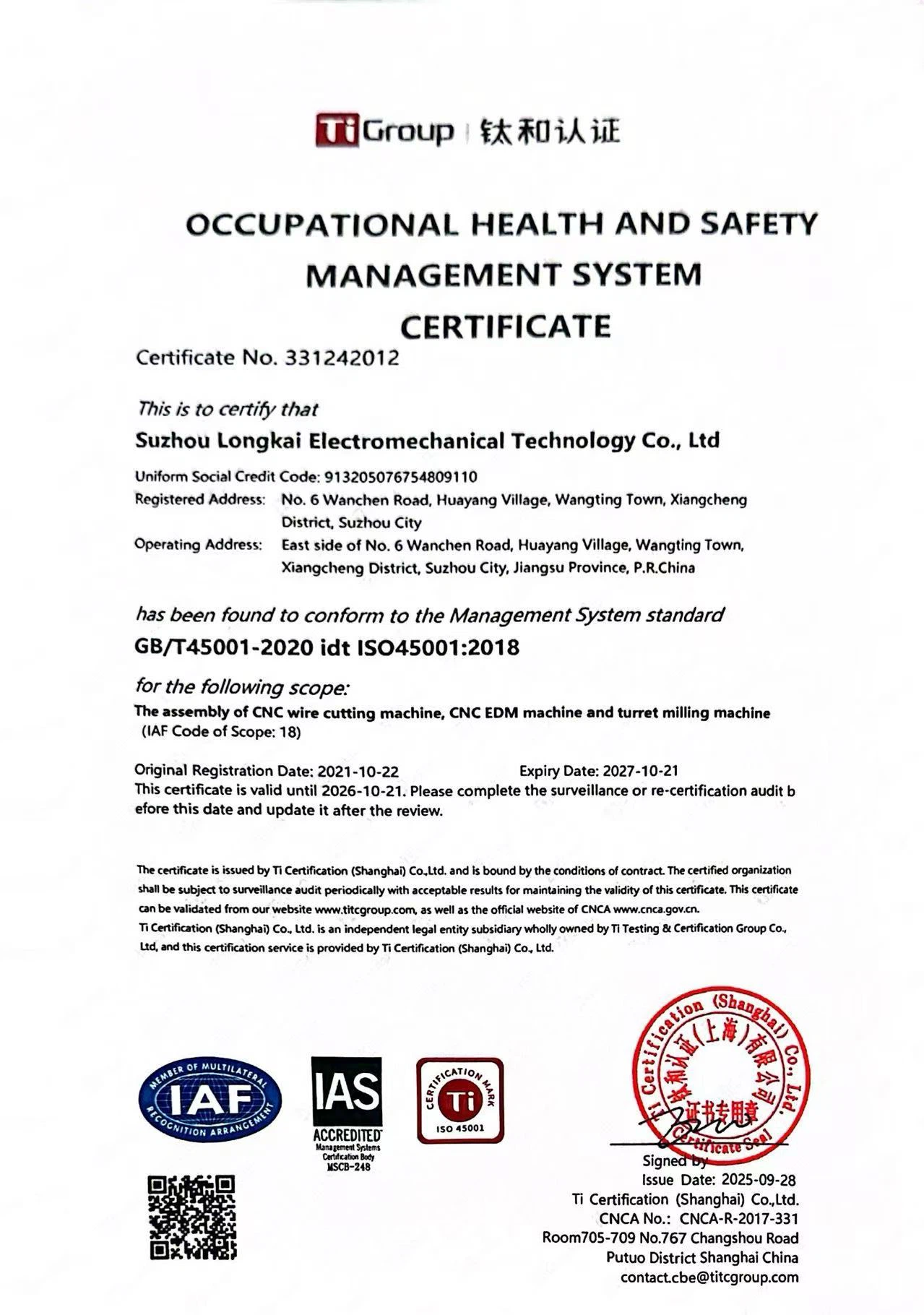
3.Occupational Health And Safety Management System Certificate
Hot Tags: medium speed EDM wire cutting CNC machine, China medium speed EDM wire cutting CNC machine manufacturers, suppliers, factory, Electronica CNC Wire Cut Machine, EDM Wire Cutting Machine, Gantry CNC Drilling and Milling Machine, Industrial CNC Milling Machine, High Precision Drilling and Milling Machine, Turret CNC Milling Machine


